The Academics and Curriculum Division of the Higher Education Commission (HEC) plays a pivotal role in shaping and strengthening the academic landscape of higher education in Pakistan. The Division is responsible for developing progressive academic policies, establishing harmonized educational standards, modernizing curricula, and promoting quality, relevance and international alignment of academic programmes offered by Higher Education Institutions (HEIs).
Through initiatives such as the Undergraduate Education Policy, Uniform Semester System Guidelines, National Curriculum Review Committees, academic equivalence and international degree collaboration frameworks, the Division strives to ensure that graduates acquire relevant knowledge, professional competencies, practical skills and ethical values to succeed in their careers and contribute meaningfully to society.
The Division also promotes academic excellence by recognizing outstanding contributions of university faculty through initiatives such as the Best University Teacher Award, Distinguished National Professor and Professor Emeritus programmes. Furthermore, it facilitates the engagement of experienced professionals through the Professor of Practice policy guidelines and supports the recognition of exceptional contributions through national honours and awards.
Vision:
Through these complementary interventions, the Division seeks to foster a progressive, inclusive and globally competitive higher education ecosystem that advances graduate outcomes, recognizes and promotes university faculty excellence, and strengthens the academic and professional capacity of universities.
To transform Pakistan's higher education system through excellence in academic policies, guide institutions in designing curricula based on outcome-based education, market needs and international standards to produce globally competitive graduates while promoting university faculty excellence through recognition of achievements and strengthening academic capacity of Higher Education Institutions.
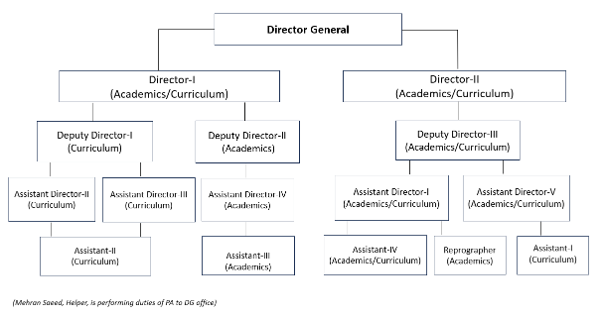
Organogram
Functions of Division
- Academic Policies and Curriculum Excellence: Formulation, review, and implementation of academic policies and frameworks, including the Undergraduate Education Policy, Semester Guidelines Policy, Dual, Double and Joint Degree Policy, Liberal Arts Framework, and Outcome-Based Education (OBE).
- Skills, Competencies, and Graduate Employability: Coordination of National Skills Competency Tests, productive overseas employment initiatives through country destination centers (CDCs).
- Curriculum Development: Facilitation and oversight of curriculum development, review and modernization across academic disciplines through National Curriculum Review Committees (NCRCs), comprising experts from academia, industry, R&D organizations, relevant government and policy-making bodies, and international experts, as appropriate. These initiatives aim to ensure academic relevance, quality and alignment with national priorities, international standards and evolving professional requirements, while integrating emerging technologies, Artificial Intelligence (AI), human-centric innovation, sustainability and the evolving requirements of IR 5.0. The process also promotes critical thinking, creativity, innovation and future-ready competencies among graduates.
- Faculty Excellence and Academic Recognition: Promotion of teaching excellence, recognition of distinguished academic contributions and introduction of industry/field experts through initiatives such as the Teacher Excellence Framework, Best University Teacher Award (BUTA), Distinguished National Professor, Professor Emeritus, and Professor of Practice.
- Academic Collaboration and International Engagement: Facilitation of national and international academic partnerships, dual, double and joint degree arrangements, international student NOCs, and strategic initiatives to strengthen global academic cooperation.
Strategic Initiatives and Stakeholder Engagement: Lead and coordinate the National Skills Competency Test (NSCT), a flagship national initiative of HEC aimed at assessing the competencies and industry readiness of Computing and IT graduates, identifying skills gaps, and strengthening alignment between higher education and industry; coordinate national academic events, MOOCs development initiatives, and productive overseas employment initiatives through Country Destination Centers (CDCs); participate in HEI Academic Councils to ensure compliance with HEC policies and academic standards and provide guidance to HEIs on academic matters; and collaborate with relevant ministries, HEIs, industry, professional bodies, research organizations, and national and international partners on educational matters.
Engr. Waheed Ahmed Mangi
Director General
Tel (office): 051-90402100
email: whahmed@hec.gov.pk
